
How to Apply for Malaysia’s VEP (Vehicle Entry Permit): A 2026 Step-by-Step Guide for Singapore Drivers
If you drive a Singapore-registered car into Malaysia — whether for work in Johor Bahru, weekend getaways or family visits — you must have an approved and activated Vehicle Entry Permit (VEP) with a working RFID tag on your vehicle. Since 1 July 2025, Malaysia has fully enforced this requirement at both the Woodlands Causeway and the Tuas Second Link. No valid VEP means an immediate RM300 fine, and you will not be allowed to leave Malaysia until it is settled.
This guide walks you through the entire process — what the VEP is, the documents you need, how to apply on the official portal, how to collect and activate your RFID tag, and how to link it to a Touch ‘n Go eWallet. We also cover the separate set of fee changes for vehicles entering Singapore.
Quick Navigation
- 2026 Update — What’s Changed
- What Is the VEP?
- VEP Penalties — What Happens Without One
- Documents You Need (Checklist)
- How to Apply — Step by Step
- How to Collect and Activate Your RFID Tag
- Linking Your VEP to the Touch ‘n Go eWallet
- The Other VEP — Driving Into Singapore (2027 Fee Changes)
- Common Mistakes to Avoid
- Frequently Asked Questions
2026 Update — What’s Changed
Before you start, here is what is new for cross-border drivers as of May 2026:
- Full enforcement is live. Malaysia’s VEP has been strictly enforced since 1 July 2025. The grace period is over — there is no longer any “drive first, register later” option.
- RM300 fine and exit restriction. A Singapore vehicle caught without a valid, activated VEP receives an RM300 compound fine (about S$91) and cannot leave Malaysia until it is paid.
- RFID tags are valid for 5 years and are non-transferable. If you change vehicles, you must apply for a brand-new VEP.
- Fees for entering Singapore are rising. Separately, the LTA announced on 6 February 2026 that the VEP fee for foreign vehicles entering Singapore will rise from 1 January 2027 (see the section below).
- ERP2 on-board units for foreign vehicles. From 1 April 2026, foreign-registered vehicles can install an ERP2 OBU in Singapore ahead of the system’s 2027 rollout.
What Is the VEP?
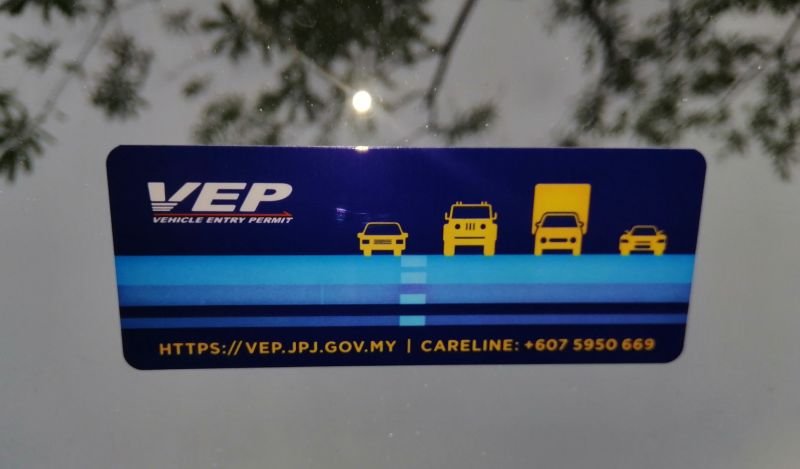
The Vehicle Entry Permit (VEP) is an electronic permit issued by Malaysia’s Road Transport Department (JPJ) to foreign-registered vehicles entering the country by land. Once approved, your VEP is paired with an RFID tag — a tamper-proof sticker you fix to your windscreen or headlamp.
When you pass through a checkpoint, RFID readers identify your vehicle automatically. The tag is also used to pay the RM20 Road Charge on entry into Johor and to pay tolls on Malaysian expressways through the designated RFID lanes. A VEP is valid for 5 years from activation and is tied to one specific vehicle — it cannot be moved to another car.
Not to be confused with: the VEP for entering Singapore
There are two different VEP systems, and it is easy to mix them up. This guide is about the Malaysia VEP — the permit a Singapore-registered car needs to enter Malaysia, managed by JPJ. There is also a separate VEP for foreign (Malaysian-registered) vehicles entering Singapore, managed by the Land Transport Authority (LTA). It has different fees and rules, and we cover it briefly in the 2027 fee changes section below. If you drive a Singapore car into Malaysia, the Malaysia VEP is the one you need.
VEP Penalties — What Happens Without One
Enforcement is firm and the consequences are immediate:
- RM300 compound fine. A Singapore vehicle without a valid, activated VEP is issued an on-the-spot RM300 fine (roughly S$91, depending on the exchange rate).
- You cannot leave. Unlike an ordinary traffic summons, this one carries an exit restriction — your vehicle cannot leave Malaysia until the fine is paid or the VEP is properly registered and activated.
- Higher penalties if contested. Drivers may challenge the summons in court, but if they lose, the fine can rise to as much as RM2,000.
- Cashless payment only. Fines are settled at JPJ counters, JPJ mobile units, or through the MyEG online platform.
The simple takeaway: never drive across the border on the assumption that you can “sort it out later”. Register early and confirm your VEP is fully activated before you travel.
Documents You Need (Checklist)
Have digital copies of the following ready before you begin — clear photos or scans on your phone or computer:
- An account on the official JPJ VEP portal
- Your vehicle log card (downloadable from LTA’s OneMotoring portal)
- Your Certificate of Entitlement (COE) details
- Your vehicle chassis number
- A valid motor insurance certificate that covers use in West Malaysia
- Your NRIC (for Singaporeans and PRs) or passport (for foreigners)
- A Touch ‘n Go eWallet account (set this up in advance — see below)
Note: some sources indicate a vehicle with less than 6 months of COE validity remaining may not be eligible for a VEP. We recommend confirming current eligibility rules directly on the JPJ VEP portal before applying.
Frequent cross-border driving is one of the most common reasons our customers at Royal Motor Grandeur look closely at COE validity and running costs when choosing a car — a car with healthy COE runway saves you the hassle of re-applying for a VEP sooner than expected
How to Apply — Step by Step
The whole application is done online and is a one-time setup per vehicle.
- Create an account. Go to the official VEP portal at vep.jpj.gov.my and register a profile. You will receive an email to verify your account.
- Log in and verify. Confirm your email, then sign in with your new account.
- Add your vehicle details. Enter your vehicle information — model, COE details and chassis number — or upload your vehicle log card so the system can read the details.
- Submit and wait for approval. Submit your documents for review. Approval typically takes anywhere from a few days to about two weeks, depending on application volume.
- Pay the tag fee and choose delivery. Once approved, you will receive an email. Log back in to pay the RFID tag processing fee of RM10 (about S$3) and select how you want to receive your tag — self-collection or courier delivery.
Tip: Demand surges around school holidays, long weekends and major public holidays. Start the process at least 2 to 3 weeks before your intended travel date to give yourself buffer time.
How to Collect and Activate Your RFID Tag
Receiving the tag is not the same as activating it. Follow these steps:
- Collect your tag.
You can self-collect at a VEP collection centre — for example at Danga Bay in Johor Bahru, or at the centre in Woodlands — or pay an additional service and courier fee to have it delivered. Collection centres usually require an appointment, which you book when you pay. Always check the portal for the current list of centres and their addresses, as these are updated from time to time. - Install the tag.
Fix it to a clean, dry spot on the left headlamp (passenger side) or the top-left corner of the windscreen, away from metal parts. If you collect in person, staff can install it for you. - Acknowledge and activate.
Log in to the VEP portal, complete the “tag acknowledgement” step for your vehicle and enter the RFID serial number. You may also need to upload a photo of the installed tag with your licence plate visible. - Wait for confirmation.
Activation can take several working days. Your VEP is not valid until activation is confirmed by email.
Linking Your VEP to the Touch ‘n Go eWallet
The VEP and RFID tag do not store money themselves. Payments — the RM20 Road Charge on entry and Malaysian expressway tolls — are handled through Touch ‘n Go (TNG).
- Download the Touch ‘n Go eWallet app and register an account before you apply for your VEP.
- Choose the correct ID type. Singaporeans should select NRIC; non-Singaporeans should select Passport. Choosing the wrong ID type can cause a mismatch with your VEP and force you to start over with a new account.
- Top up your balance so funds are available for the Road Charge and tolls.
- Be aware of limits. Foreign users may face some restrictions on the TNG eWallet — certain features and top-up methods can require a Malaysian phone number. A physical Touch ‘n Go card is a useful backup.
The Other VEP — Driving Into Singapore (2027 Fee Changes)
This section is about the reverse direction — foreign-registered (Malaysian) vehicles entering Singapore. This VEP is managed by the LTA and is separate from the Malaysia VEP covered above. We include it here because the rules are changing and it affects anyone planning around cross-border costs.
On 6 February 2026, the LTA announced the following changes, effective 1 January 2027:
- The VEP fee for foreign-registered cars entering Singapore rises from S$35 to S$50 per day.
- The VEP fee for foreign-registered motorcycles rises from S$4 to S$7 per day.
- The Goods Vehicle Permit (GVP) fee rises from S$40 to S$70 per calendar month.
- The annual 10 free VEP days and the free VEP hours on weekdays will be removed. From 2027, the fee applies on all days except weekends and Singapore public holidays.
Separately, in preparation for the ERP2 system, foreign-registered vehicles can install an ERP2 on-board unit (OBU) in Singapore from 1 April 2026. The OBU is not mandatory for most foreign vehicles, but the device costs the prevailing rate of S$158.70 (inclusive of 9% GST) until 31 December 2026, excluding installation charges. From 2027, foreign vehicles entering Singapore without an OBU pay a flat-rate ERP fee of S$10 per ERP operational day for cars and S$3 for motorcycles.
All fees and policy details above are accurate as of May 2026 and are sourced from official JPJ and LTA announcements. Figures are subject to change — always verify on vep.jpj.gov.my and onemotoring.lta.gov.sg before you travel.
💡 Bonus Tips for Smooth Travel
✅ Top up your Touch ‘n Go eWallet or PayDirect TNG Card for tolls
✅ Renew insurance that covers West Malaysia
✅ Ensure road tax is valid
✅ Always bring printed copies of VEP approval when crossing
Common Mistakes to Avoid
- Leaving it to the last minute. Approval and tag activation take time. Apply weeks ahead, not days.
- Confusing registration with activation. A pre-registered VEP is not a valid VEP. You must complete tag acknowledgement and activation.
- Selecting the wrong ID type in the TNG eWallet. This causes a mismatch with your VEP — double-check NRIC versus Passport.
- Forgetting that the VEP is non-transferable. When you buy or change a vehicle, the old VEP does not carry over — you must apply for a new one and de-register the old vehicle.
- Driving with insurance that does not cover Malaysia. Confirm your motor policy explicitly covers West Malaysia.
- Letting your RFID tag or COE lapse. Renew your VEP before it expires, and keep an eye on your COE validity.
Frequently Asked Questions
Do I really need a VEP to drive into Malaysia in 2026?
Yes. Since 1 July 2025, Malaysia fully enforces the VEP for all foreign-registered vehicles. Every Singapore-registered car must have an approved and activated VEP with an RFID tag to enter, with no grace period remaining.
How long does VEP approval take?
Online approval usually takes from a few days up to about two weeks, and tag activation can take several more working days. Apply at least 2 to 3 weeks before you plan to travel, and longer ahead of school holidays and long weekends.
How much does the VEP cost?
The RFID tag processing fee is RM10 (about S$3). Self-collection or courier delivery adds a service or courier fee on top. Separately, there is an RM20 Road Charge each time a foreign private vehicle enters Malaysia.
What is the RM300 VEP fine and when do I get it?
A Singapore vehicle entering Malaysia without a valid, activated VEP receives an on-the-spot RM300 compound fine (about S$91). The vehicle cannot leave Malaysia until the fine is paid. If contested in court and the driver loses, the fine can rise to as much as RM2,000.
Where can I collect and activate my RFID tag?
You can self-collect at a VEP collection centre — such as Danga Bay in Johor Bahru or the Woodlands centre — or have the tag couriered to you. To activate it, install the tag, then complete the tag acknowledgement step on the VEP portal. Your VEP is only valid once activation is confirmed.
Is the VEP transferable if I buy a new car?
No. The VEP and RFID tag are tied to one specific vehicle and are non-transferable. If you change cars, you must de-register the old vehicle and apply for a brand-new VEP for the new one.
Do I need a Touch ‘n Go eWallet for the VEP?
Yes. The VEP and RFID tag do not hold money. A Touch ‘n Go eWallet (or physical TNG card) is used to pay the RM20 Road Charge and Malaysian expressway tolls. Singaporeans should register with NRIC as the ID type.
What is the Road Charge and how is it different from the VEP?
The VEP is your entry permit; the RM10 fee covers the RFID tag. The Road Charge is a separate RM20 toll deducted from your linked Touch ‘n Go each time a foreign private vehicle enters Malaysia. Commercial vehicles and motorcycles are exempt from the Road Charge.
Are VEP fees for entering Singapore changing in 2027?
Yes. The LTA announced on 6 February 2026 that, from 1 January 2027, the VEP fee for foreign-registered cars entering Singapore rises from S$35 to S$50 per day, motorcycles from S$4 to S$7 per day, and the GVP from S$40 to S$70 per month. The 10 free VEP days and free weekday hours will be removed. Foreign vehicles can also install an ERP2 OBU from 1 April 2026, priced at S$158.70 (inclusive of 9% GST) until 31 December 2026.
Planning a Car That’s Ready for the Causeway
Because a VEP is non-transferable, every time you change vehicles you start the process again — so it pays to choose a car you will be happy driving across the border for years. If you regularly travel between Singapore and Malaysia, look for a vehicle with strong COE runway, comfortable highway manners and room for the family.
At Royal Motor Grandeur in Ubi, our team can help you find the right new or pre-owned car for cross-border life — from efficient MG electric models to spacious 7-seater MPVs. We also offer a one-stop service for bank loans, insurance, 0% downpayment schemes and loan tenures of up to 10 years.
Visit our showroom at
61 Ubi Avenue 2 Automobile Megamart Singapore 01-21 , Singapore 408898, 3 Ang Mo Kio Street 62, #01-23, Link@AMK, Singapore 569139, or get in touch for a no-obligation quote.
Last updated: May 2026
Sources
- Land Transport Authority — “Revisions to Vehicle Entry Permit and Goods Vehicle Permit Schemes, and OBU Installation for Foreign-Registered Vehicles” (6 February 2026)
- Road Transport Department of Malaysia (JPJ) — official VEP portal, vep.jpj.gov.my
- LTA OneMotoring — foreign vehicle and ERP2 information, onemotoring.lta.gov.sg
- Public news coverage of VEP enforcement from 1 July 2025