
· Last updated: 3 November 2026
Key takeaways
- Cost per charge: a 10–80% charge costs roughly $26–$33 on an MG4 Urban EV or MGS5 EV (about $0.69–$0.75 per kWh, as of October 2026; rates vary by operator and location).
- How often: most Singapore drivers charge about once a week. At around 50 km a day, a compact EV like the MG4 Urban needs one or two sessions.
- The 10–80% rule: fast charging slows sharply above about 80%, so that is the sweet spot for DC charging.
- Battery life: a study of 22,700+ EVs found average degradation of 2.3% a year, about 81.6% capacity left after eight years.
If you are buying your first EV, charging is probably the part that worries you most: where, how fast, how much, and what it does to the battery. The good news is that it is simpler than it looks. Below are the questions our customers actually ask, answered plainly, with the MG4 Urban EV and MGS5 EV as worked examples.

AC vs DC Charging: What’s the Difference?
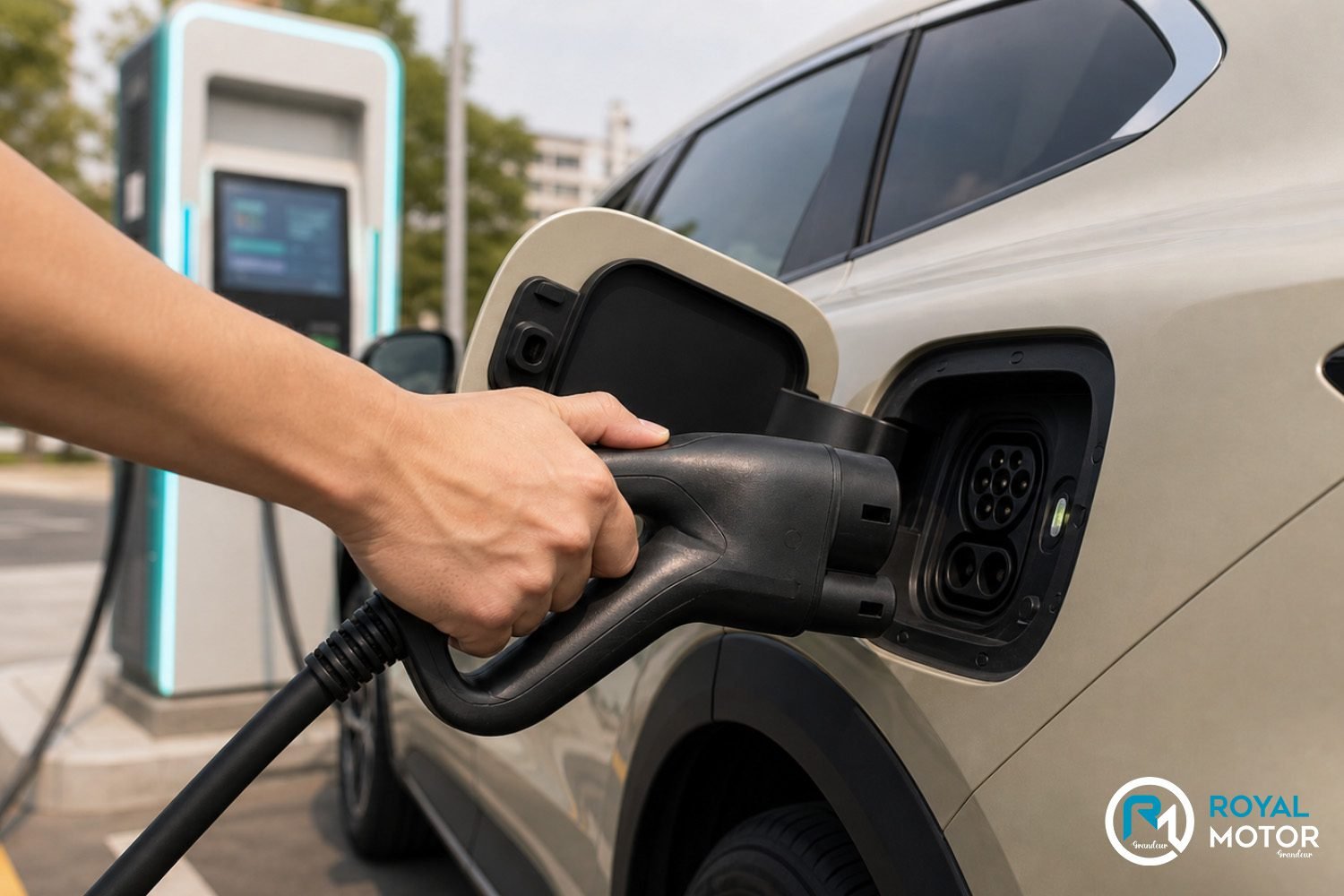
The difference is where the electricity is converted. With AC, the car’s onboard charger does the work. With DC, the charger itself does it, which is why it can be much faster.
| AC (slow) | DC (fast) | |
|---|---|---|
| How it works | Through the car’s onboard charger | Conversion happens in the charger |
| Speed | Slow, suited to long stops | Fast, usually under an hour |
| Typical price | About $0.69/kWh | About $0.75/kWh |
| Connector | Type 2 | CCS2 (Combo 2) |
| Best for | Overnight, at the office, HDB carparks | Top-ups on the go, long trips |
Prices approximate, as of October 2026. Rates vary by operator and location.
How Much Does It Cost to Charge an EV in Singapore?

The formula is simple:
Battery size (kWh) × % charged × price per kWh = cost
Charging from 10% to 80% means adding 70% of the battery. These examples exclude charging losses.
| Model | Energy added (10→80%) | AC at $0.69/kWh | DC at $0.75/kWh |
|---|---|---|---|
| MG4 Urban EV (54 kWh) | 54 × 0.7 = 37.8 kWh | about $26 | about $28 |
| MGS5 EV (62 kWh) | 62 × 0.7 = 43.4 kWh | about $30 | about $33 |
A weekly example
Say you drive 50 km a day, which is about the Singapore average. That is 350 km a week. The MG4 Urban EV uses 15.5 kWh per 100 km, so 350 km needs about 54 kWh, roughly $37 a week at $0.69 per kWh. That is about one full battery’s worth, so in practice you would charge once or twice a week rather than once.
What do different operators charge?
Prices vary by operator and location. As of October 2026, the market median is around $0.69 per kWh.
| Operator | AC (approx. per kWh) | DC (approx. per kWh) |
|---|---|---|
| Charge+ | $0.65 | $0.75 |
| Shell Recharge | $0.69 | $0.86 |
| CDG Energy | $0.70 | $0.76 |
| SP Mobility | $0.70 | $0.89 |
No operator is “the best” for everyone. The right one is usually whichever is closest to where you park, work or shop. Compare live prices on the MyTransport.SG app before you plug in.
We also run charging credit offers on our electric models from time to time. [verify current: e.g. FREE 3 years charging credit] See our current promotions.
EV vs Hybrid vs Petrol: What Does a Month of Driving Cost?
Charging cost only means something next to the alternative. Here is the monthly energy cost for the MGS5 EV, the Honda Vezel Hybrid and the Honda Vezel Petrol, all available at RMG, assuming 50 km a day (about 1,500 km a month).
| MGS5 EV | Vezel Hybrid | Vezel Petrol | |
|---|---|---|---|
| Rated consumption | 17.1 kWh/100 km | 4.2 L/100 km [verify with RMG] | 5.8 L/100 km |
| Energy price used | $0.69/kWh (public AC) | $3.60/L (95-octane) | $3.60/L (95-octane) |
| Per 100 km | about $11.80 | about $15.10 | about $20.90 |
| Per month (1,500 km) | about $177 | about $227 | about $313 |
| Per year | about $2,120 | about $2,720 | about $3,760 |
Rated figures; real-world consumption varies with driving style and conditions. EV figure excludes charging losses. Petrol price is the 95-octane pump price for 18–24 October 2026, before card and loyalty discounts. Energy cost only: purchase price, insurance, servicing and tax are not included.
What this tells you:
- Against the Vezel Hybrid, the S5 saves roughly $50 a month in energy. The hybrid narrows the gap a lot, and it needs no charging access at all.
- Against the Vezel Petrol, the saving is roughly $136 a month.
- The S5 is also a larger car than the Vezel, so this compares energy cost, not size or price.
Which one suits you depends on where you park and how far you drive. If you can charge at home or at work, an EV’s running cost advantage is real. If you cannot, a hybrid may be the easier choice. Not sure? Read our guide to petrol or electric car, or talk to us and we will run the numbers for your own routine.
Why Does Charging Slow Down After 80%?
DC charging power is highest when the battery is low and tapers as it fills. Above about 80%, it slows sharply: the battery management system reduces power to protect the cells. That is why manufacturers quote “10–80%” times rather than “0–100%”.
On the MG4 Urban EV, 10–80% takes about 30 minutes (DC up to 82 kW). On the MGS5 EV, it takes about 26 minutes. The last 20% would take far longer than the first 70%, so on the road it is usually quicker to unplug at 80%.
A cold battery also charges more slowly, though that is rarely an issue in Singapore’s climate.
Does DC Fast Charging Damage the Battery?
Not meaningfully, for normal use. Geotab’s study of 22,700+ EVs found average battery degradation of 2.3% per year. Vehicles using DC fast charging for more than 12% of their charging showed slightly higher degradation, and heavy high-power use reached about 3.0% a year.
Two things to keep in perspective. First, the 3.0% figure relates to heavy high-power use. The MG4 Urban EV charges at up to 82 kW on DC, which is below the high-power range. The MGS5 EV charges faster, so it is worth keeping DC for when you need it. Second, the practical advice is the same for any EV: use AC for routine charging and DC when you need speed.
Battery chemistry matters a little here:
- LFP (lithium iron phosphate): more tolerant of frequent charging and heat, with lower energy density.
- NMC (nickel manganese cobalt): higher energy density and longer range, but more sensitive to sitting at a high charge and to heat.
- Which one your car has: Ask us and we will confirm for the exact car you are considering.
Should I Charge My EV to 100%?
For daily use, charging to around 80% is fine, and it is gentler on the battery. If your car has an LFP battery, an occasional charge to 100% is also fine. LFP batteries have a flat voltage curve, so the system sometimes needs a full charge to calibrate its range estimate. Some manufacturers recommend charging an LFP battery to 100% periodically.
NMC batteries prefer not to sit at a high charge for long, so charge to 100% only when you need the range.
Geotab’s data points the same way: degradation only accelerates if a car spends more than 80% of its time outside the 20–80% range. Occasional full charges are not the problem.
Where Can I Charge in Singapore?
- HDB carparks: the national target is for all HDB towns to be EV-ready.
- Condos: home or condo chargers must be installed by a registered installer [verify process with RMG]. Charging from a 13A household socket, or using extension cords, is not allowed (TR25 standard).
- Malls and offices: usually AC chargers, good for long stops. Malls may also charge normal parking on top of charging.
- Petrol stations and fast-charging hubs: DC chargers for quick top-ups.
Singapore is working towards 60,000 charging points by 2030. To find chargers, prices, power and plug type, use the MyTransport.SG app or the operator’s own app.
Idle fees and charging etiquette
Once your car has finished charging, move it. SP Mobility and Shell Recharge charge an idle fee of $0.50 per minute after a grace period, capped at $40. Some operators set idle fees site by site with no cap. Moving your car promptly is good manners and saves money.
How Long Does an EV Battery Last in Singapore’s Heat?
Heat does matter, but the effect is modest. In Geotab’s study, vehicles that spent more than 35% of their time above 25°C degraded about 0.4% faster per year. Singapore is warm all year, so it is worth knowing, and worth putting in context: average degradation across the study was 2.3% a year, leaving about 81.6% capacity after eight years.
If your car has an LFP battery, it tends to handle heat well, which suits our climate. And for peace of mind, the MG S5 EV comes with a 10-year battery warranty.
Frequently Asked Questions
How much does it cost to charge an EV in Singapore?
As of October 2026, public charging costs roughly $0.69 per kWh on AC and $0.75 per kWh on DC, though rates vary by operator and location. A 10–80% charge on an MG4 Urban works out to about $26 on AC or $28 on DC, excluding charging losses. Check the MyTransport.SG app for live prices.
How long does it take to charge an MG4 Urban or MGS5?
On a DC fast charger, the MG4 Urban takes about 30 minutes to go from 10% to 80%, and the MGS5 about 26 minutes. AC charging is slower and suits overnight or office charging.
Does fast charging damage my EV battery?
Not meaningfully for normal use. A Geotab study of 22,700+ EVs found average degradation of 2.3% per year, with heavy high-power use reaching about 3.0%. Use AC for routine charging and DC when you need the speed, such as on a long trip or a busy day.
Why does my EV charge slower after 80%?
DC charging is fastest when the battery is low and tapers as it fills. Above about 80%, the battery management system sharply reduces power to protect the cells. That is why manufacturers quote 10–80% times, and why it is usually quicker to unplug at 80% than to wait for 100%.
Should I charge my EV to 100%?
Daily charging to around 80% is fine. An occasional 100% charge is also fine for LFP batteries and helps the system calibrate its range estimate, while NMC batteries prefer not to sit at a high charge. Check your model’s battery type and MG’s recommendation.
Can I charge an EV at home with a normal socket?
No. Charging from a 13A household socket, or with extension cords, is not allowed under the TR25 standard. Home and condo chargers must be installed by a registered installer. Ask us before you buy and we will point you in the right direction.
How often do I need to charge an EV in Singapore?
Most drivers charge about once a week. Average daily driving in Singapore is around 50 km, so a compact EV such as the MG4 Urban would typically need one or two sessions a week at that distance. Your own routine matters more: top up when it suits you, not when the battery runs low.
What is an idle fee?
An idle fee is a charge for leaving your car plugged in after charging has finished. SP Mobility and Shell Recharge charge $0.50 per minute after a grace period, capped at $40. Some operators set fees site by site with no cap, and malls may also charge normal parking. Move your car when done.
How long does an EV battery last?
Geotab’s study of 22,700+ EVs found average degradation of 2.3% per year, or about 81.6% capacity left after eight years. Vehicles that spent much of their time above 25°C degraded about 0.4% a year faster. Our MGS5 comes with a 10 years battery warranty.
See How Easy EV Charging Really Is
Test-drive the MG4 Urban or MG S5 and we’ll walk you through charging in person.
WhatsApp us to book a test drive »
Request a free quote »
Prefer to speak? Call +65 6741 4911 or visit us at Royal Motor Grandeur, 61 Ubi Avenue 2, Automobile Megamart #01-21, Singapore 408898 & 3 Ang Mo Kio Street 62, #01-23, Link@AMK, Singapore 569139.
Keep reading: our full electric car range, the best electric SUV for Singapore families, PHV and electric car insurance, and our financing options.
Sources
- LTA / PowerEveryMove: EV Charging 101
- Motorist.sg: 2026 Singapore EV charging rates
- Electric Autonomy: Latest Geotab study finds EV batteries lose just 2.3% life per year
- Motorist.sg: Singapore fuel prices, 27 October 2026
Last updated: 3 November 2026